Arabica vs Robusta Coffee: Key Differences in Taste, Caffeine, Price, and Quality
Coffee is enjoyed in different parts of the world, but not all coffee beans are the same. If you have ever purchased coffee from a supermarket, visited a coffee shop, or explored different coffee brands, you may have noticed two names appearing frequently: Arabica and Robusta.
These are the two most commercially important coffee species in the global coffee industry. Both are used to produce the coffee millions of people drink every day, but they have noticeable differences in flavour, caffeine content, growing conditions, appearance, and price.
So, when comparing Arabica vs Robusta coffee, which one is better?
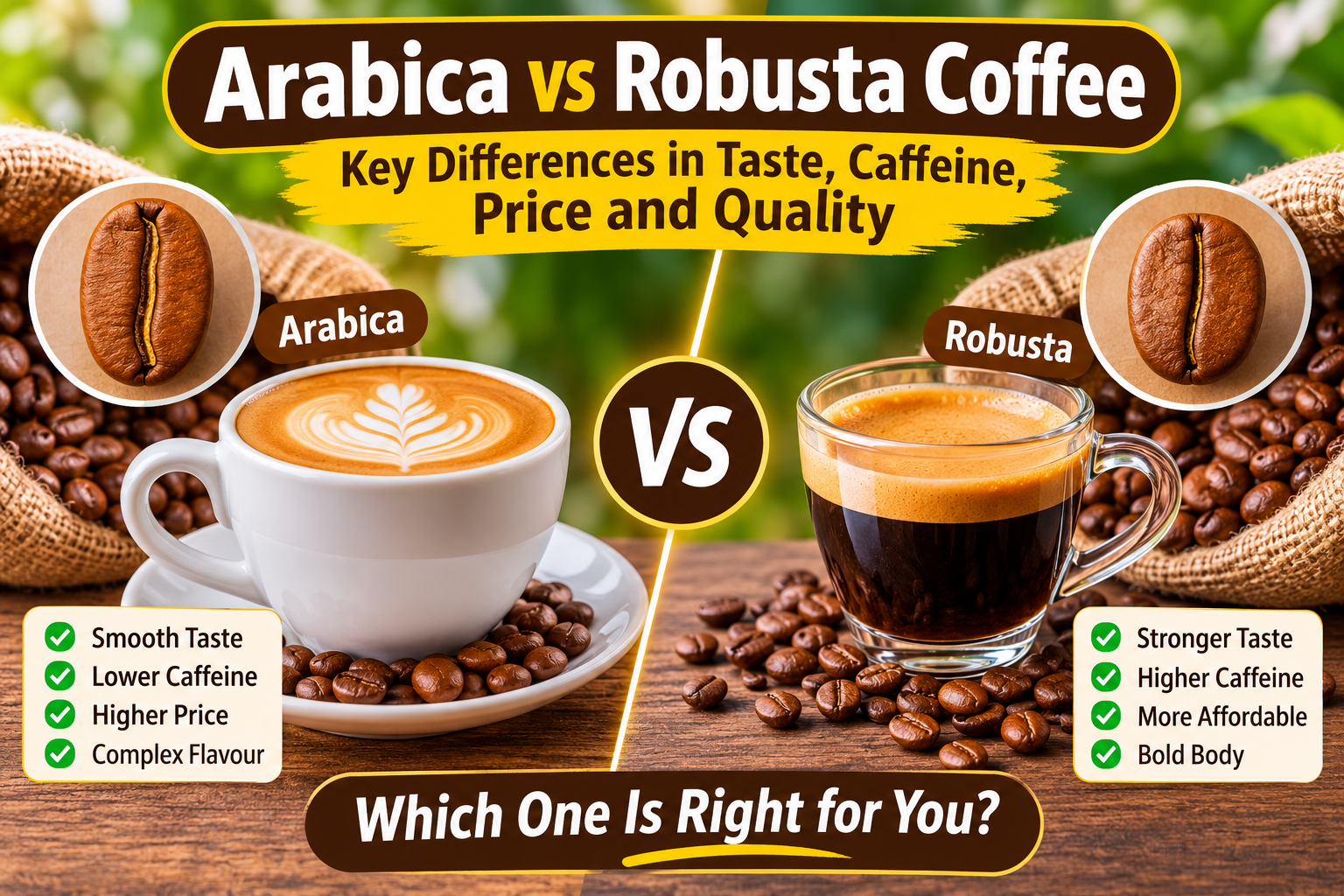
Arabica is generally known for its smooth flavour, pleasant aroma, and complex taste. Robusta, on the other hand, is recognised for its stronger, more bitter flavour, higher caffeine content, and ability to grow under a wider range of environmental conditions.
However, choosing between them is not simply about deciding which coffee is stronger or more expensive. Your personal taste, brewing method, budget, and preferred caffeine level all matter.
In this guide, you will learn the main differences between Arabica and Robusta coffee, how each bean tastes, which contains more caffeine, how they are grown, and how to choose the right coffee for your everyday needs.
What Is Arabica Coffee?
Arabica coffee, scientifically known as Coffea arabica, is one of the most popular coffee species in the world.
It originated in the highland regions of Ethiopia and later spread to other coffee-growing countries. Today, Arabica is cultivated in many parts of Latin America, Africa, and Asia.
Arabica beans are widely appreciated for their smooth taste, pleasant fragrance, and diverse flavour characteristics.
Depending on where they are grown and how they are processed, Arabica coffees may have notes of chocolate, caramel, nuts, berries, citrus, or flowers.
This variety of flavours makes Arabica especially popular among specialty coffee drinkers and people who enjoy exploring different coffee experiences.
Arabica plants generally prefer higher elevations, moderate temperatures, and suitable rainfall. They can be more sensitive to pests, diseases, and environmental changes than Robusta plants.
Because growing and maintaining Arabica coffee can require more attention, its production costs are sometimes higher.
Main Characteristics of Arabica Coffee
- Generally has a smooth and balanced flavour.
- Often contains fruity, floral, sweet, or chocolate-like notes.
- Usually has less caffeine than Robusta.
- Commonly grows at higher elevations.
- Has oval-shaped beans with a curved centre crease.
- Often commands a higher market price.
- Is widely used in specialty coffee products.
What Is Robusta Coffee?
Robusta coffee, scientifically known as Coffea canephora, is another major commercial coffee species.
It is commonly called Robusta because of its relatively hardy growing characteristics. Compared with Arabica, Robusta plants can tolerate warmer temperatures and a wider range of growing conditions.
Robusta is cultivated in several tropical regions, particularly in parts of Africa and Southeast Asia.
Countries such as Vietnam, Brazil, Indonesia, and Uganda are important producers of Robusta coffee.
Robusta beans are known for their strong flavour, higher caffeine content, and heavier body.
Their taste is often described as earthy, woody, nutty, or bitter. Some Robusta coffees may also have chocolate-like characteristics, depending on their quality and processing.
Because Robusta plants are generally more resistant to certain pests and diseases, they can be less demanding to cultivate than Arabica.
Robusta is commonly used in instant coffee, commercial coffee blends, and espresso blends where a stronger flavour and thicker crema are desirable.
Main Characteristics of Robusta Coffee
- Has a stronger and often more bitter flavour.
- Generally contains more caffeine than Arabica.
- Often has earthy, woody, or nutty flavour notes.
- Can grow under warmer conditions.
- Usually has rounder beans with a straighter centre crease.
- Is commonly used in instant coffee and commercial blends.
- Often costs less than comparable Arabica coffee.
Arabica vs Robusta Coffee: What Are the Main Differences?
The easiest way to understand these two coffee varieties is to compare their important characteristics. Although both come from coffee plants, they differ in several ways.
| Feature | Arabica | Robusta |
|---|---|---|
| Scientific name | Coffea arabica | Coffea canephora |
| Caffeine content | Lower | Higher |
| Taste | Smooth and complex | Strong and often bitter |
| Acidity | Generally higher | Generally lower |
| Body | Light to medium, sometimes full | Often heavier and fuller |
| Aroma | Often sweet and fragrant | Often earthy and strong |
| Growing conditions | Usually higher elevations | Usually lower elevations |
| Plant resistance | More sensitive | Generally more resistant |
| Bean shape | Oval | Rounder |
| Price | Often more expensive | Often more affordable |
| Common uses | Specialty coffee and filter coffee | Instant coffee and espresso blends |
These are general characteristics rather than strict rules. Coffee quality, growing location, roasting, and preparation can significantly change the final flavour.
1. Taste Difference Between Arabica and Robusta
Taste is one of the most noticeable differences when comparing Arabica vs Robusta coffee.
What Does Arabica Coffee Taste Like?
Arabica coffee is generally appreciated for its smooth and balanced flavour. Depending on the origin and processing method, it may offer:
- Sweet caramel notes.
- Chocolate-like flavours.
- Fruity characteristics.
- Floral aromas.
- Mild nutty undertones.
- Pleasant acidity.
For example, an Arabica coffee grown in Ethiopia may have floral or fruity characteristics, while some coffees from Brazil may have chocolate and nutty notes. This variety makes Arabica attractive to people who enjoy different flavour experiences.
What Does Robusta Coffee Taste Like?
Robusta coffee usually has a stronger and more intense flavour. Its common flavour characteristics include:
- Earthy notes.
- Woody undertones.
- Dark chocolate flavours.
- Nutty characteristics.
- Noticeable bitterness.
- A heavier mouthfeel.
Some people enjoy this strong taste, especially when drinking espresso or coffee with milk. However, not every Robusta coffee tastes harsh or unpleasant. High-quality Robusta, when properly grown, processed, and roasted, can produce an enjoyable cup.
Which tastes better?
If you prefer smooth, complex, and sometimes fruity coffee, Arabica may be your preferred choice. If you enjoy bold, intense, and less acidic coffee, Robusta may suit your taste better.
2. Caffeine Content: Which Coffee Is Stronger?
Another important difference between Arabica and Robusta is their caffeine content. Robusta generally contains almost twice as much caffeine as Arabica by weight, although actual amounts vary depending on the beans and preparation.
As a general guide:
- Arabica beans commonly contain approximately 1.2% to 1.5% caffeine by weight.
- Robusta beans commonly contain approximately 2.2% to 2.7% caffeine by weight.
This higher caffeine concentration contributes to Robusta’s naturally bitter taste and may help the plant defend itself against certain insects.
However, higher caffeine content does not automatically mean that every cup of Robusta coffee contains twice as much caffeine as every cup of Arabica.
The final caffeine level depends on several factors, including:
- The quantity of coffee used.
- The brewing method.
- The serving size.
- The roast and bean characteristics.
- Whether the coffee is pure or blended.
Which should you choose?
If you want a coffee with naturally higher caffeine content, Robusta is generally the stronger option. If you prefer a lower-caffeine coffee, Arabica may be a better starting point. However, decaffeinated coffee is a more suitable option if you need to minimise caffeine significantly.
3. Appearance: How to Identify Arabica and Robusta Beans
You can sometimes distinguish Arabica and Robusta by looking at their physical appearance. Although roasted beans may look similar, unroasted green coffee beans often have noticeable differences.
Arabica Beans
Arabica beans are usually oval or elongated in shape.
They typically have a curved centre line that resembles the letter S.
Their appearance may vary depending on the variety, growing location, and processing method.
Robusta Beans
Robusta beans are generally rounder and smaller than Arabica beans.
Their centre line is usually straighter, making them somewhat easier to distinguish from Arabica when examining green beans.
However, appearance alone is not always reliable, particularly when the beans have been roasted or processed.
Checking the product label and buying from a reputable coffee supplier is a better way to confirm the coffee species.
4. Growing Conditions: Where Do Arabica and Robusta Grow?
The environments in which coffee plants grow play an important role in determining their characteristics. Arabica and Robusta have different environmental preferences.
Arabica Growing Conditions
Arabica generally performs best in cooler tropical highland environments.
It is commonly cultivated at elevations of approximately 1,000 to 2,000 metres above sea level, although suitable elevations vary by location. Arabica plants generally prefer:
- Moderate temperatures.
- Consistent rainfall.
- Well-drained soil.
- Suitable shade and sunlight.
- Stable growing conditions.
Because Arabica is relatively sensitive to temperature changes and certain plant diseases, farmers must pay close attention to growing conditions.
Major Arabica-producing countries include Brazil, Colombia, Ethiopia, Honduras, and Peru.
Robusta Growing Conditions
Robusta is generally more tolerant of warmer conditions than Arabica. It is often cultivated at lower elevations, commonly below 1,000 metres, although its growing range is not limited to this elevation.
Robusta plants generally tolerate:
- Higher temperatures.
- Warmer tropical climates.
- A wider range of growing conditions.
- Greater exposure to certain pests and diseases.
Important Robusta-producing countries include Vietnam, Uganda, Indonesia, and Brazil. These differences in growing conditions help explain why both species are important to coffee production around the world.
5. Price Difference Between Arabica and Robusta
Arabica coffee is often more expensive than Robusta, although prices depend on quality, availability, origin, and market conditions. There are several reasons why Arabica may command a higher price.
First, Arabica plants can be more sensitive to environmental conditions and certain diseases.
Second, growing Arabica often requires careful farm management and harvesting practices.
Third, specialty Arabica coffees may receive additional attention during harvesting, processing, grading, and roasting.
Robusta, on the other hand, can be relatively economical to produce because its plants are generally hardier and can offer higher yields under suitable conditions.
However, this does not mean that all Robusta coffee is cheap or that all Arabica coffee is expensive.
High-quality fine Robusta can command premium prices, while lower-grade Arabica may be relatively affordable.
When buying coffee, consider its quality, freshness, origin, and processing rather than judging it by price alone.
6. Which Coffee Is Better for Espresso?
Both Arabica and Robusta can be used to make espresso, but they produce different results.
Arabica espresso is often appreciated for its smoothness, aromatic complexity, and balanced flavour. Depending on the beans, it may have chocolate, fruit, caramel, or floral characteristics.
Robusta is commonly included in espresso blends because it can contribute:
- A stronger flavour.
- A fuller body.
- More intense bitterness.
- A thicker layer of crema.
Crema is the golden-brown foam that forms on top of a freshly prepared espresso.
Some traditional Italian-style espresso blends combine Arabica and Robusta to balance aroma, flavour, body, and crema.
For people who prefer a smoother espresso, a high-quality Arabica may be an excellent choice.
For those who enjoy a bolder espresso with a stronger finish, a blend containing Robusta may be more appealing.
7. Health Benefits of Arabica vs Robusta Coffee
Both Arabica and Robusta contain naturally occurring plant compounds, including antioxidants.
These compounds have attracted scientific interest because they may contribute to the body’s defence against oxidative stress.
However, it is important to understand that neither coffee species should be considered a medicine or a treatment for disease.
Potential Benefits of Arabica Coffee
Arabica coffee contains caffeine and several naturally occurring compounds, including chlorogenic acids. When consumed in moderation, it may:
- Temporarily improve alertness.
- Support concentration.
- Contribute antioxidants to the diet.
- Provide an enjoyable alternative to sugar-rich beverages when consumed black.
Potential Benefits of Robusta Coffee
Robusta also contains antioxidants and other natural compounds. Because it generally contains more caffeine than Arabica, it may produce a stronger stimulating effect.
Its potential benefits include:
- Temporary improvements in alertness.
- Increased concentration.
- Contribution of naturally occurring antioxidant compounds.
- A stronger flavour without necessarily requiring additional sugar.
Is Arabica Healthier Than Robusta?
There is no simple answer. Arabica is not automatically healthier because it has less caffeine, and Robusta is not automatically unhealthy because it contains more caffeine.
Your overall caffeine intake, serving size, preparation method, and personal health conditions are more important.
For most healthy adults, the FDA considers up to 400 mg of caffeine per day an amount generally not associated with negative effects.
People who are pregnant, sensitive to caffeine, or managing certain health conditions may need lower amounts.
8. Arabica vs Robusta: Which Is Better for Everyday Drinking?
The best coffee for everyday drinking depends on your preferences and how your body responds to caffeine.
If you enjoy a balanced flavour and pleasant aroma, Arabica may be a suitable everyday option.
If you prefer a strong coffee with more caffeine, Robusta may be worth trying. You should also consider how you prepare your coffee.
For example:
- Filter coffee: Arabica is a popular choice because of its aromatic and complex flavour.
- Espresso: Both species work well, depending on the desired taste.
- Instant coffee: Robusta is commonly used, although instant coffee can contain Arabica or blends.
- Coffee with milk: Robusta can provide a stronger flavour that remains noticeable when mixed with milk.
- Black coffee: Arabica is often preferred by people who enjoy tasting different flavour notes.
Ultimately, there is no universal winner. The best coffee is the one that matches your taste preferences, caffeine needs, and budget.
9. Can Arabica and Robusta Coffee Be Mixed?
Yes. Arabica and Robusta beans are frequently combined to create coffee blends. Blending allows coffee producers and roasters to combine the characteristics of both species.
For example, Arabica can contribute smoothness, aroma, and flavour complexity, while Robusta can add body, bitterness, and additional caffeine.
A blend may contain different proportions depending on the intended taste.
Some blends contain mostly Arabica with a smaller percentage of Robusta, while others use a more balanced combination.
Coffee blending is particularly common in espresso production because different beans can complement one another.
However, the quality of the final coffee depends on the quality of the beans and how carefully the blend is prepared.
10. How to Choose Between Arabica and Robusta Coffee
If you are unsure which coffee to buy, consider these practical points.
Choose Arabica if:
- You enjoy smooth and balanced coffee.
- You appreciate fruity, floral, or chocolate-like flavours.
- You prefer generally lower caffeine content.
- You enjoy specialty coffee and exploring different origins.
- You regularly drink filter coffee or pour-over coffee.
Choose Robusta if:
- You enjoy strong and bold coffee.
- You prefer a more bitter flavour.
- You want a coffee with naturally higher caffeine content.
- You enjoy traditional espresso blends.
- You prefer an affordable everyday coffee option.
Choose a blend if:
- You want a balance between flavour and strength.
- You enjoy espresso with a fuller body.
- You want to experience characteristics of both coffee species.
A useful way to decide is to purchase small quantities of each type, prepare them using the same brewing method, and compare their taste. This simple approach can help you discover which coffee you genuinely enjoy.
Frequently Asked Questions About Arabica vs Robusta Coffee
1. Which is better, Arabica or Robusta?
Neither is universally better. Arabica is generally preferred for its smooth, complex flavour, while Robusta is appreciated for its stronger taste and higher caffeine content. Your personal preference determines which is better for you.
2. Does Robusta have more caffeine than Arabica?
Yes. Robusta generally contains almost twice as much caffeine by weight as Arabica. However, the caffeine in a prepared cup depends on the serving size and brewing method.
3. Why is Arabica more expensive than Robusta?
Arabica can be more expensive because it often requires more careful growing conditions and farm management. Specialty Arabica also attracts higher prices because of its flavour characteristics and production standards.
4. Is Arabica coffee less bitter than Robusta?
Generally, yes. Arabica tends to have a smoother and more balanced taste, while Robusta often has stronger bitterness. However, roasting and brewing methods can significantly influence bitterness.
5. Can Robusta coffee be used for espresso?
Yes. Robusta is commonly used in espresso blends because it can contribute a fuller body, stronger flavour, and thicker crema.
6. Is 100% Arabica coffee better quality?
Not necessarily. The term 100% Arabica identifies the coffee species, not its overall quality. Growing conditions, harvesting, processing, storage, and roasting also influence quality.
7. Is Robusta coffee good for health?
Robusta contains antioxidants and caffeine, like Arabica. It can be enjoyed as part of a balanced diet, provided your caffeine consumption remains appropriate for your health needs.
8. Which coffee is better for beginners?
Arabica is often a good starting point for beginners because of its generally smooth and balanced flavour. However, people who enjoy strong, bold beverages may prefer Robusta.
9. Which coffee is best for black coffee?
Arabica is a popular choice for black coffee because its flavour characteristics can be easier to appreciate without milk or sugar. Nevertheless, high-quality Robusta can also make enjoyable black coffee.
10. Is instant coffee made from Arabica or Robusta?
Instant coffee can be made from Arabica, Robusta, or a combination of both. The species used depends on the manufacturer, product quality, and intended flavour.
Conclusion
Understanding the differences between Arabica and Robusta coffee makes it easier to choose a coffee that suits your taste and lifestyle.
Arabica is generally known for its smooth flavour, pleasant aroma, and complex taste. It is a popular choice among specialty coffee enthusiasts and people who enjoy exploring different coffee origins.
Robusta is recognised for its higher caffeine content, stronger flavour, and hardier growing characteristics. It is widely used in instant coffee, commercial blends, and espresso.
Both have their advantages, and neither should automatically be considered superior.
If you enjoy smooth, aromatic coffee, try Arabica. If you prefer a stronger, more intense cup, consider Robusta. If you want a combination of both characteristics, a carefully prepared blend may be the ideal choice.
The best way to discover your favourite is to experiment with different beans, roasting styles, and brewing methods.
Ultimately, great coffee is not just about whether it is Arabica or Robusta. It is about finding the flavour, quality, and experience you enjoy most.