Types of Coffee Beans Explained: A Complete Beginner’s Guide to Arabica, Robusta, Liberica and Excelsa
Coffee is one of the most popular beverages in the world, enjoyed by millions of people every day. From a strong morning espresso to a smooth afternoon latte, coffee comes in different flavours, aromas, strengths and varieties. However, have you ever wondered why some coffee tastes sweet and fruity while others are bitter, bold or slightly chocolatey?
The answer often starts with the type of coffee bean used.
Understanding the different types of coffee beans can help you choose the right coffee for your taste, brewing method and lifestyle. Whether you are a beginner exploring coffee for the first time or someone who simply wants to know more about your favourite drink, learning about coffee beans is a great place to start.
In this guide, we explain the four main types of coffee beans, their characteristics, caffeine content, flavour profiles and differences. We will also explore how to choose the best coffee beans for your needs.
What Are the Main Types of Coffee Beans?
There are four commonly recognised main types of coffee beans:
- Arabica coffee beans
- Robusta coffee beans
- Liberica coffee beans
- Excelsa coffee beans
Although thousands of coffee varieties exist, these four are the most commonly discussed commercial coffee species.
Each type has unique characteristics, including flavour, aroma, growing conditions, caffeine levels and market availability.
Here is a quick overview:
| Coffee Bean Type | General Flavour | Caffeine Level | Common Characteristics |
|---|---|---|---|
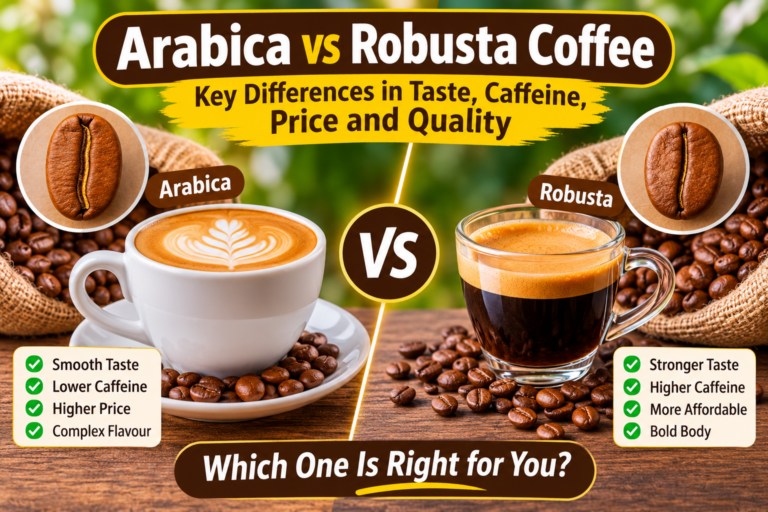
| Arabica | Smooth, sweet and fruity | Lower | Aromatic and complex |
| Robusta | Strong, bitter and earthy | Higher | Bold flavour and rich crema |
| Liberica | Smoky, woody and fruity | Varies | Large beans and unusual aroma |
| Excelsa | Tart, fruity and complex | Generally lower than Robusta | Often used in blends |
Let’s explore each coffee bean type in more detail.
1. Arabica Coffee Beans
Arabica is one of the most popular and widely consumed types of coffee beans in the world. It is scientifically known as Coffea arabica and is especially appreciated for its smooth taste, pleasant aroma and complex flavour.
Arabica coffee is commonly grown in countries such as Ethiopia, Brazil, Colombia, Kenya and Guatemala.
These coffee plants generally grow best in higher-altitude regions with suitable temperatures, consistent rainfall and well-drained soil.
What Does Arabica Coffee Taste Like?
Arabica coffee is known for its balanced and relatively mild flavour. Depending on where it is grown and how it is processed and roasted, it may have notes of:
- Chocolate
- Caramel
- Nuts
- Berries
- Citrus fruits
- Floral aromas
- Brown sugar
Some Arabica coffees taste naturally sweet, while others have a noticeable fruity acidity.
This variety of flavours makes Arabica a popular choice among specialty coffee drinkers.
How Much Caffeine Does Arabica Contain?
Arabica generally contains less caffeine than Robusta.
Its caffeine content is typically around 1.2% to 1.5% of the bean’s dry weight, although actual levels vary according to the coffee variety and growing conditions.
This does not mean Arabica coffee is caffeine-free or necessarily weak. A cup of Arabica can still provide a significant amount of caffeine, depending on the serving size and brewing method.
Who Should Choose Arabica Coffee?
Arabica is a good choice for people who enjoy:
- Smooth and balanced coffee.
- Sweet or fruity flavour notes.
- Aromatic coffee with different flavour layers.
- Pour-over, drip coffee and other filter brewing methods.
- Exploring specialty coffee from different growing regions.
If you are new to coffee and prefer something less harsh or bitter, Arabica is an excellent starting point.
2. Robusta Coffee Beans
Robusta is another major type of coffee bean. Its scientific name is Coffea canephora.
Compared with Arabica, Robusta coffee plants are generally more resistant to certain diseases and pests. They can also grow successfully in warmer and lower-altitude environments.
Major Robusta-producing countries include Vietnam, Brazil, Indonesia and Uganda.
Robusta is especially important in the commercial coffee industry because it is widely used in instant coffee production and espresso blends.
What Does Robusta Coffee Taste Like?
Robusta coffee is known for its strong, bold and intense flavour.
Its taste is often described as:
- Earthy
- Nutty
- Woody
- Bitter
- Chocolate-like
- Sometimes grainy
Compared with many Arabica coffees, Robusta generally has less perceived acidity and a heavier flavour.
However, the quality of Robusta beans matters. Well-grown and carefully processed fine Robusta can offer a more balanced and enjoyable flavour than ordinary commercial-grade beans.
How Much Caffeine Does Robusta Contain?
One of the biggest differences between Arabica and Robusta is caffeine content.
Robusta typically contains approximately 2% to 2.7% caffeine by dry bean weight, making it naturally more caffeinated than Arabica.
This higher caffeine concentration contributes to its stronger, more bitter taste.
However, remember that the caffeine in your cup also depends on how much coffee you use and how you prepare it.
Who Should Choose Robusta Coffee?
Robusta may be suitable for people who enjoy:
- Strong and bold coffee.
- A more intense and bitter flavour.
- Espresso with a thick layer of crema.
- Coffee blends with a stronger body.
- Affordable everyday coffee options.
If you prefer coffee with a powerful taste, Robusta is worth exploring.
3. Liberica Coffee Beans
Liberica is a less common but fascinating type of coffee bean.
Scientifically known as Coffea liberica, this coffee species is believed to have originated in West and Central Africa. Today, it is also cultivated in parts of Southeast Asia, particularly the Philippines and Malaysia.
Liberica is different from Arabica and Robusta in several ways. Its coffee cherries and beans are often larger, and its plants can grow into considerably taller trees.
What Does Liberica Coffee Taste Like?
Liberica has a distinctive flavour that makes it stand out from more familiar coffee types.
Depending on its origin, processing and roasting, its flavour may include:
- Smoky notes
- Woody flavours
- Fruity characteristics
- Floral aromas
- Nutty undertones
- A slightly bold or unusual finish
Some people enjoy Liberica because it offers an experience that is different from conventional coffee.
Its distinctive aroma and flavour can make it an interesting choice for coffee enthusiasts who enjoy discovering unusual varieties.
How Much Caffeine Does Liberica Contain?
Liberica’s caffeine content varies depending on the specific variety and growing conditions.
It does not have the same consistently established commercial caffeine profile as Arabica and Robusta, so it is better not to assume that every Liberica coffee is either particularly strong or mild.
Who Should Choose Liberica Coffee?
Liberica may appeal to people who:
- Enjoy exploring unusual coffee flavours.
- Want to try something different from Arabica and Robusta.
- Appreciate woody and smoky flavour notes.
- Are interested in African and Southeast Asian coffee traditions.
Although Liberica is less widely available internationally, it remains an important part of coffee diversity.
4. Excelsa Coffee Beans
Excelsa is another interesting coffee type with a distinctive flavour profile.
It was historically classified as a separate coffee species, but modern botanical classification generally places it within Coffea liberica, often as the variety known as Coffea liberica var. dewevrei.
Despite this classification, Excelsa continues to be discussed separately in the coffee industry because of its unique characteristics.
It is mainly associated with parts of Southeast Asia.
What Does Excelsa Coffee Taste Like?
Excelsa coffee is known for its unusual combination of flavour characteristics.
It can offer:
- Tart fruitiness
- Berry-like notes
- Dark fruit flavours
- Floral characteristics
- A slightly tangy finish
- Complex flavour layers
Its flavour can be quite different from the familiar chocolate and nutty notes associated with many commercial coffees.
Excelsa is sometimes used in coffee blends to add complexity and a distinctive fruity character.
How Much Caffeine Does Excelsa Contain?
Excelsa is generally described as having a lower caffeine concentration than Robusta. However, caffeine levels can vary depending on the plant material and growing conditions.
For this reason, it is best to check specific product information rather than relying entirely on the coffee name.
Who Should Choose Excelsa Coffee?
Excelsa may be suitable for coffee drinkers who:
- Enjoy fruity and tangy coffee.
- Like experimenting with different flavours.
- Want to explore unusual coffee varieties.
- Prefer coffee blends with additional flavour complexity.
Although it is less common than Arabica and Robusta, Excelsa offers something interesting for adventurous coffee drinkers.
Arabica vs Robusta vs Liberica vs Excelsa: What Is the Difference?
Now that you understand the four main coffee bean types, it is useful to compare them side by side.
| Feature | Arabica | Robusta | Liberica | Excelsa |
|---|---|---|---|---|
| Scientific classification | Coffea arabica | Coffea canephora | Coffea liberica | Liberica variety |
| Flavour | Smooth and complex | Bold and earthy | Smoky and woody | Fruity and tart |
| Caffeine | Lower | Higher | Variable | Generally lower than Robusta |
| Common uses | Specialty and filter coffee | Espresso blends and instant coffee | Specialty and regional coffee | Coffee blends |
| Availability | Very high | Very high | Limited | Limited |
| Growing conditions | Often higher altitudes | Generally warmer and lower altitudes | Tropical conditions | Tropical conditions |
The biggest differences are their flavour profiles, caffeine concentrations, growing characteristics and availability.
There is no single best coffee bean for everyone. Your ideal choice depends on your personal preferences.
Which Coffee Bean Has the Most Caffeine?
If caffeine is your main concern, Robusta generally contains the highest amount among the four commonly discussed coffee types.
The typical caffeine concentrations by dry bean weight are:
- Robusta: Approximately 2% to 2.7%.
- Arabica: Approximately 1.2% to 1.5%.
- Liberica: Variable.
- Excelsa: Generally lower than Robusta, with variation between samples.
These figures are approximate and should not be treated as fixed values for every coffee variety.
It is also important to understand that the strongest-tasting coffee is not always the most caffeinated.
For example, a dark-roasted Arabica may taste stronger or more bitter than a lighter-roasted Robusta, even though Robusta generally contains more caffeine by weight.
The amount of coffee used, serving size and brewing method also influence the caffeine content of your final drink.
Which Coffee Bean Tastes the Best?
There is no universal answer because taste is personal.
Some people enjoy sweet and smooth coffee, while others prefer strong, bitter or fruity flavours.
Here is a simple guide to help you choose:
Choose Arabica if you like smooth coffee.
Arabica is ideal for people who enjoy balanced flavours, pleasant aromas and subtle sweetness.
Choose Robusta if you like strong coffee.
Robusta is suitable for people who enjoy bold flavours, bitterness and a stronger coffee character.
Choose Liberica if you enjoy unusual flavours.
Liberica is worth trying if you like smoky, woody and distinctive coffee aromas.
Choose Excelsa if you enjoy fruity coffee.
Excelsa offers a different flavour experience, particularly for people who appreciate tart and complex notes.
The best approach is to try small quantities of different coffee beans before purchasing larger packages.
Does Coffee Bean Type Affect the Taste of Your Coffee?
Yes. The type of coffee bean plays an important role in determining the final taste of your coffee.
However, the bean species is only one part of the process.
Several other factors influence the flavour of coffee.
1. Coffee Origin
Where coffee is grown can affect its flavour.
For example, some Ethiopian coffees are known for floral and fruity characteristics, while certain Brazilian coffees are associated with chocolate and nutty flavours.
These are general tendencies rather than strict rules. Coffee from the same country can taste different depending on the farm, variety and processing method.
2. Roasting Level
Roasting transforms green coffee beans into the brown beans used for brewing.
The main roasting levels include:
- Light roast: Often highlights fruity, floral and acidic characteristics.
- Medium roast: Usually offers a balance of sweetness, acidity and body.
- Dark roast: Often produces deeper, bolder flavours with more roasted or bitter notes.
The roasting process can significantly change how a particular coffee tastes.
3. Processing Method
Coffee processing refers to how the fruit surrounding the coffee seed is removed after harvesting.
Common methods include:
- Washed processing: Often produces a cleaner and more defined flavour.
- Natural processing: Can create fruitier and sweeter flavour characteristics.
- Honey processing: Often offers a balance between fruitiness and sweetness.
The processing method can make two coffees from the same species taste noticeably different.
4. Brewing Method
How you prepare coffee also affects its flavour.
For example, espresso produces a concentrated drink, while pour-over brewing can highlight delicate flavour characteristics.
French press brewing generally produces a fuller-bodied cup because more coffee oils remain in the drink.
Therefore, choosing the right coffee beans is important, but proper preparation matters too.
How to Choose the Best Coffee Beans for Your Needs
Buying coffee beans can feel confusing, especially when you are unfamiliar with coffee labels and terminology.
Here are some practical tips to help you make a better choice.
1. Understand Your Taste Preference
Start by identifying the flavours you enjoy.
If you like chocolate, nuts and caramel, consider trying medium-roasted Arabica.
If you prefer stronger and more intense flavours, explore Robusta or Arabica-Robusta blends.
If you enjoy fruity flavours, look for coffees with natural or honey processing and suitable tasting notes.
2. Check the Roast Date
Freshly roasted coffee generally retains more of its desirable aroma and flavour than coffee that has been stored for a long time.
Look for a clearly displayed roast date rather than relying only on an expiry date.
3. Buy Whole Beans When Possible
Whole coffee beans generally retain their aroma better than pre-ground coffee because grinding increases the surface area exposed to air.
If possible, purchase whole beans and grind them shortly before brewing.
4. Consider Your Brewing Equipment
Different coffee beans work well with different brewing methods.
For espresso, medium or dark-roasted Arabica and Arabica-Robusta blends are popular choices.
For pour-over coffee, many people prefer light or medium-roasted Arabica.
For French press, medium and dark roasts can produce a satisfying, full-bodied drink.
However, these are recommendations rather than strict rules. You can experiment with different beans and brewing methods to discover what you enjoy.
5. Store Your Coffee Properly
Coffee beans are sensitive to air, moisture, heat and light.
To maintain their freshness:
- Keep coffee in an airtight container.
- Store it in a cool, dry place.
- Avoid direct sunlight.
- Keep it away from strong-smelling foods.
- Purchase quantities you can use while the coffee remains fresh.
Proper storage helps preserve the aroma and flavour of your coffee.
Frequently Asked Questions About Types of Coffee Beans
1. What are the four main types of coffee beans?
The four commonly recognised types are Arabica, Robusta, Liberica and Excelsa. Arabica and Robusta dominate global commercial coffee production, while Liberica and Excelsa are less widely available.
2. Which coffee bean is the strongest?
Robusta generally has the highest caffeine concentration among the four types. It also has a bold, earthy and often bitter flavour.
However, coffee strength can refer to caffeine content, flavour intensity or concentration. These are not necessarily the same thing.
3. Is Arabica better than Robusta?
Neither is automatically better. Arabica is often preferred for its smooth flavour and complexity, while Robusta is appreciated for its bold taste, higher caffeine content and contribution to espresso blends.
Your preference should determine which one you choose.
4. Which coffee beans are best for beginners?
Arabica is often a good starting point for beginners because it offers a wide range of balanced flavours.
Medium-roasted Arabica is particularly worth trying if you want a coffee that is not excessively bitter or acidic.
5. Are coffee beans naturally bitter?
Coffee beans contain naturally occurring compounds that contribute to bitterness. However, bitterness is also influenced by roasting, brewing temperature, extraction time and coffee quality.
A well-prepared cup of coffee can have a pleasant balance of sweetness, acidity and bitterness.
6. Are dark-roasted coffee beans stronger than light-roasted beans?
Dark-roasted coffee often tastes bolder and more bitter than light-roasted coffee.
However, darker roasting does not automatically mean higher caffeine content. The difference in caffeine between roast levels is relatively small, particularly when comparing equal weights of coffee.
7. Can you mix Arabica and Robusta coffee beans?
Yes. Arabica and Robusta are commonly blended to create coffee with a balance of flavour, body, caffeine and crema.
Some espresso blends use Arabica for its flavour complexity and Robusta for its stronger body and crema.
8. Are Liberica and Excelsa the same?
They are closely related. Excelsa was historically classified as a separate coffee species, but modern botanical classification places it within the Liberica species. Nevertheless, coffee producers and enthusiasts still commonly discuss Excelsa separately because of its distinctive flavour.
Final Thoughts: Understanding the Different Types of Coffee Beans
Understanding the different types of coffee beans makes it easier to appreciate what goes into every cup of coffee.
Arabica is popular for its smooth flavour and complexity, Robusta is known for its bold taste and higher caffeine content, Liberica offers distinctive smoky and woody characteristics, while Excelsa provides interesting fruity and tart flavours.
Although these coffee types have different characteristics, none is automatically the best. The right choice depends on your preferred taste, brewing method and caffeine preferences.
If you are just beginning your coffee journey, start with Arabica, explore Robusta when you want something bolder, and gradually experiment with Liberica and Excelsa.
Most importantly, enjoy discovering the flavours you love. After all, the best coffee beans are the ones that make every cup enjoyable.